No. 570中文
What does this sign, marking, or signal mean?
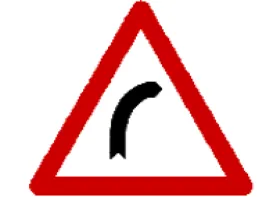
- Right curve. Correct answer
- Left curve.
- Continuous curves, right first.
No. 571中文
What does this sign, marking, or signal mean?
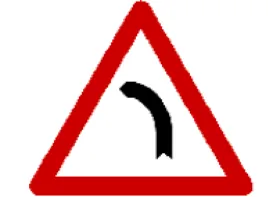
- Left curve. Correct answer
- Right curve.
- Continuous curves, left first.
No. 572中文
What does this sign, marking, or signal mean?
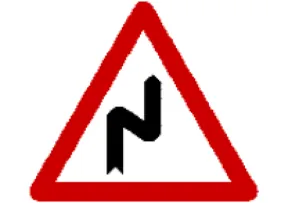
- Continuous curves, right first. Correct answer
- Left curve.
- Continuous curves, left first.
No. 573中文
What does this sign, marking, or signal mean?
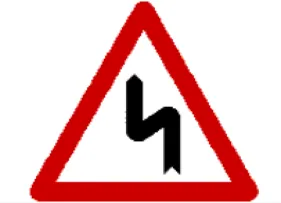
- Continuous curves, left first. Correct answer
- Right curve.
- Continuous curves, right first.
No. 574中文
What does this sign, marking, or signal mean?
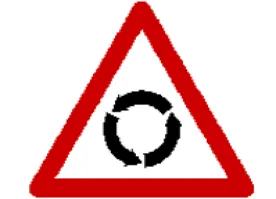
- Left curve.
- Roundabout. Correct answer
- Fork road.
No. 575中文
What does this sign, marking, or signal mean?
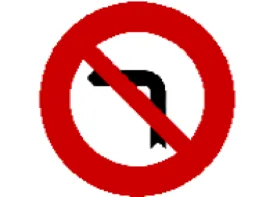
- No U-turn.
- No left turn. Correct answer
- No overtaking.
No. 576中文
What does this sign, marking, or signal mean?
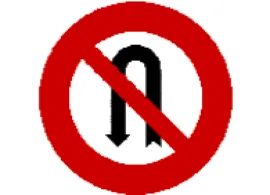
- No left turn.
- No U-turn. Correct answer
- No oncoming traffic.
No. 577中文
What does this sign, marking, or signal mean?
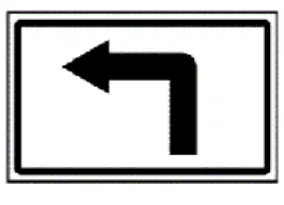
- Left curve.
- Left turn direction.
- Go straight then turn left. Correct answer
No. 578中文
What does this sign, marking, or signal mean?
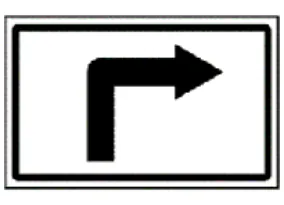
- Go straight then turn right. Correct answer
- Go straight then turn left.
- Left turn prescribed direction.
No. 579中文
What does this sign, marking, or signal mean?
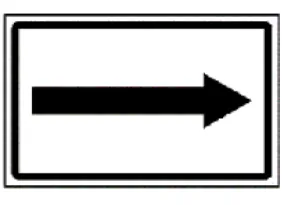
- Left turn direction.
- Right turn direction. Correct answer
- Left and right turn direction.
No. 580中文
The white dashed line in the figure is:
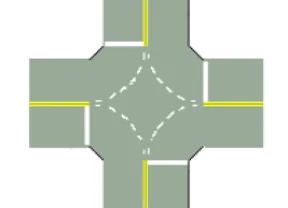
- Intersection traffic guidance line. Correct answer
- Box junction marking.
- Channelization line.
No. 581中文
Left arm raised up, palm facing right and slightly curved, indicates:
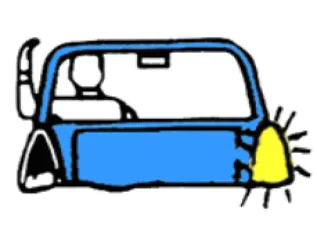
- Right turn. Correct answer
- Left turn.
- Allowing rear vehicle to overtake.
No. 582中文
Left arm extended horizontally, palm facing down, indicates:
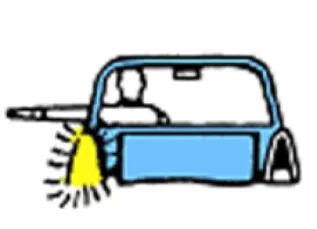
- Right turn.
- Left turn. Correct answer
- Slow down.
No. 583中文
On a road with a dividing island separating fast and slow lanes, which of the following turning rules is correct for large vehicle drivers?
- Slow lane vehicles may turn left, and fast lane vehicles may also turn right, as long as they watch for oncoming traffic.
- Slow lane vehicles may not turn left, and fast lane vehicles may not turn right, except where signs, markings, or signals indicate otherwise. Correct answer
- Large vehicle drivers may choose their turning method according to traffic flow conditions.
No. 584中文
Regarding a motor vehicle approaching an intersection without signals or with malfunctioning signals and no traffic officer directing traffic, which of the following statements is INCORRECT?
- Vehicles on a secondary road shall stop and yield to vehicles on a main road.
- Where no signs, markings, or signals designate main or secondary roads, vehicles on the road with fewer lanes shall stop and yield to vehicles on the road with more lanes.
- When both vehicles are going straight or both are turning, the vehicle on the right shall stop and yield to the vehicle on the left. Correct answer
No. 585中文
Regarding the rules for motor vehicles proceeding and turning at intersections, which of the following statements is INCORRECT?
- When merging from two same-direction lanes into one lane, if there is no straight-through lane, vehicles in the inner lane shall yield to vehicles in the outer lane. Correct answer
- When merging from two same-direction lanes into one lane, vehicles shall yield to vehicles in the straight-through lane.
- During traffic congestion, vehicles in inner and outer lanes shall mutually yield, taking turns alternately vehicle by vehicle, while maintaining safe following distances and intervals.
No. 586中文
When a vehicle is turning, which of the following is INCORRECT?
- A motor vehicle on a road with two or more same-direction lanes shall not drive in the inner lane except when preparing to turn left. Correct answer
- At an intersection with dedicated left-turn or right-turn lanes, straight-through vehicles shall not occupy the dedicated turning lanes.
- At an unsignalized intersection where both roads have the same number of lanes, turning vehicles shall stop and yield to straight-through vehicles.
No. 587中文
Regarding the rules for motor vehicle drivers when turning or changing lanes, which of the following statements is CORRECT?
- Occupying the oncoming lane to make a left turn before reaching the center of an intersection is subject to a fine of NT$600–1,800. Correct answer
- At an intersection with dedicated left-turn or right-turn lanes, straight-through vehicles may drive in the dedicated lane.
- When turning left across multiple lanes, one must not enter the inner lane.
No. 588中文
When a motor vehicle driver fails to yield to oncoming straight-through traffic when turning left at an intersection, what penalty shall be imposed?
- A fine and suspension of the license plate.
- A fine of NT$600–1,800. Correct answer
- A fine and revocation of the driver's license.
No. 589中文
When a vehicle turns left (right), it should first activate the left (right) turn signal at both the front and rear of the vehicle; when changing lanes, it should first activate the signal in the direction of the intended lane change. Which of the following is correct?
- The turn signal should be displayed for 5 seconds.
- The turn signal should remain on until the turn or lane change is completed. Correct answer
- The turn signal only needs to be displayed briefly.
No. 590中文
Which of the following vehicles will cause an inner wheel difference (off-tracking) when turning?
- Small vehicles.
- Large vehicles.
- Both. Correct answer
No. 591中文
When a motor vehicle driver turns right at a multi-lane intersection, how should they choose their lane?
- Any lane may be used to turn right.
- Follow the road signs and markings, or use the outermost lane to turn. Correct answer
- Turning from the inner lane is safer.
No. 592中文
When a motor vehicle driver is turning left at an intersection and there are already vehicles waiting to turn ahead, what is the appropriate action?
- Go around the vehicle in front and turn left first.
- Wait in order behind the other vehicles. Correct answer
- Directly enter the oncoming lane to make the turn.
No. 593中文
When a motor vehicle driver is at an intersection equipped with traffic guide lines and does not follow the guide lines but cuts directly into the turning path, what applies?
- As long as it does not affect other vehicles, there is no violation.
- Failure to comply with road marking instructions is subject to a fine. Correct answer
- It is sufficient to simply slow down.
No. 594中文
A person who drives a small vehicle without having obtained a car driver's license shall be fined:
- NT$300–600.
- NT$3,600–7,200.
- NT$36,000–60,000. Correct answer
No. 595中文
Regarding the 'directional guide sign', what is its formal functional definition under traffic regulations?
- Used to indicate the route direction and number for travel. Correct answer
- Used to inform vehicle drivers that they must travel in the direction indicated by the sign, which is mandatory in nature.
- Used to mark the road section as a pedestrian priority zone where vehicles must slow down.
No. 596中文
Regarding traffic signs at roundabout sections, which of the following statements is correct?
- The 'roundabout' warning sign is placed inside the roundabout intersection, instructing vehicles to travel in a counterclockwise direction.
- The 'roundabout' warning sign is placed in advance before approaching the roundabout section, to warn of the upcoming roundabout intersection ahead. Correct answer
- The 'roundabout' warning sign and the 'roundabout travel direction' sign have the same function and can be used interchangeably.
No. 597中文
When a motor vehicle travels to an unsignalized intersection, which of the following statements is correct?
- A through vehicle must yield to a turning vehicle.
- When a through vehicle has not yet entered the intersection, the turning vehicle goes first.
- An oncoming turning vehicle must yield to a through vehicle. Correct answer
No. 598中文
A driver approaching an intersection sees a 'right turn only' compliance sign, but their destination is to the left. What should they do?
- The sign is only advisory; the driver may decide the turning direction as needed.
- They should turn right as indicated by the sign, then find another appropriate route to reach the destination. Correct answer
- They may proceed straight through the intersection and turn left at the next intersection to reach the destination.
No. 599中文
When a car travels on a road with a median island dividing fast and slow lanes, unless otherwise indicated by signs, markings, or signals, what is the general rule?
- Vehicles in the fast lane may not make a left turn.
- Vehicles in the slow lane must first merge into the fast lane before turning right.
- Vehicles traveling in the slow lane may not make a left turn. Correct answer
No. 600中文
When driving through a long tunnel and encountering an emergency such as a fire, what should the driver do?
- Stay calm, immediately pull the vehicle to the side of the tunnel, and clear the lane for emergency vehicles to enter. Correct answer
- Use the vehicle cross-passage to make a U-turn and quickly leave the scene.
- Stop the vehicle in place.
No. 601中文
Under which circumstances may a motor vehicle driver sound the horn?
- When approaching a sharp curve.
- When intending to overtake the vehicle ahead in the same lane on a suburban road.
- Both of the above are permitted. Correct answer
No. 602中文
When a car experiences a tire skid while navigating a curve, what is the safest course of action?
- Immediately press the brakes to slow down.
- Quickly turn the steering wheel to correct the direction.
- Release the accelerator and avoid sudden acceleration or sudden braking. Correct answer
No. 603中文
When a driver sees a 'Junction' warning sign ahead, how should they respond?
- There is an intersection ahead; slow down and watch for vehicles that may merge from the side. Correct answer
- The road ahead is about to end; prepare to make a U-turn or take a detour.
- The road ahead splits into two lanes; choose the inner lane and accelerate away from the diverging section.
No. 604中文
When a car approaches a multi-lane roundabout, which of the following statements about right-of-way is correct?
- Vehicles in the inner lane should be given priority. Correct answer
- Vehicles in the outer lane should be given priority.
- Vehicles coming from the wider road or the road with heavier traffic have priority to enter the roundabout.
No. 605中文
What does this sign represent?
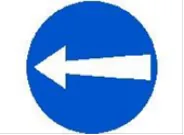
- Mandatory direction of travel. Correct answer
- One-way road.
- Park on the left side.
No. 606中文
What does this sign represent?
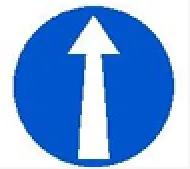
- Mandatory direction of travel. Correct answer
- One-way road.
- For motor vehicles only.
No. 607中文
When reaching an intersection with a dedicated left-turn signal, what should the driver do when the left-turn signal lights up?
- Immediately accelerate through the intersection to avoid disrupting traffic behind.
- Turn left as indicated by the signal and pay attention to other vehicles and pedestrians. Correct answer
- Stop first to observe, and turn left slowly only after confirming no vehicles are present.
No. 608中文
On a road with a dividing island separating fast and slow lanes, which of the following rules regarding turning is correct for vehicles traveling in the slow lane?
- Under safe conditions, vehicles in the slow lane may turn left at any time.
- Vehicles in the slow lane may not turn left directly. Correct answer
- Vehicles in the slow lane may turn left directly only when there are no oncoming vehicles.
No. 609中文
A car is waiting to turn left at an intersection. When the signal changes to a circular green light, how should the driver proceed?
- To maintain traffic flow, turn on the turn signal and make the left turn immediately.
- Must wait until there are no oncoming vehicles going straight, and may only turn left after confirming it is safe; preemptive passage is not allowed. Correct answer
- No need to consider oncoming straight-going vehicles; as long as you are within the center point of the intersection, you may turn left with priority.
No. 610中文
What is the meaning of the pictorial sign?
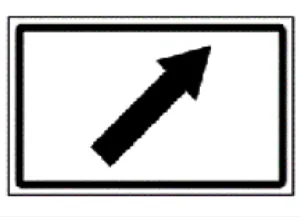
- Keep to the left.
- Right turn direction. Correct answer
- Left turn direction.
No. 611中文
When turning right at an intersection, you should first:
- Display a turn signal or hand signal. Correct answer
- Change lanes.
- Turn.
No. 612中文
When a car turns right:
- It should first display the right turn signals at the front and rear of the vehicle. Correct answer
- It should first display the left turn signals at the front and rear of the vehicle.
- Extending the right arm horizontally to the right indicates a right turn.
No. 613中文
On road sections with curve, slope, or narrow road signs, a car should:
- Speed up to pass through to avoid congestion.
- When the vehicle ahead is moving too slowly, honk to make it speed up.
- Always slow down and be prepared to stop at any time. Correct answer
No. 614中文
A vehicle in the inner lane intending to turn left at an intersection should:
- Display the turn signal 30 meters before the intersection and turn left at the center of the intersection. Correct answer
- Turn left immediately upon reaching the intersection.
- Display the right turn signal and turn left.
No. 615中文
On road sections with curve, slope, narrow bridge, or tunnel signs, or at railway level crossings:
- U-turns are allowed.
- U-turns are allowed only after slowing to about 5 km/h.
- U-turns are not allowed. Correct answer
No. 616中文
Before making a U-turn:
- Stop and display the left turn signal or hand signal, check for traffic in both directions, watch for pedestrians, then make the U-turn. Correct answer
- Glance left and right, and turn when clear.
- Honk 3 times, then make the U-turn.
No. 617中文
Which of the following is incorrect regarding left turns at an intersection?
- You may only turn left when the left-turn signal is on.
- You may turn left after straight-going vehicles have passed.
- You may rush to turn left as soon as the green light comes on. Correct answer
No. 618中文
A driver on a road with a traffic island separating fast and slow lanes, while in the fast lane:
- May turn right.
- Must not turn right. Correct answer
- No specific regulation.
No. 619中文
On roads with three or more lanes in the same direction, large vehicles must not drive in which lane, except when preparing to turn left?
- The inner lane. Correct answer
- The middle lane.
- The outer lane.